



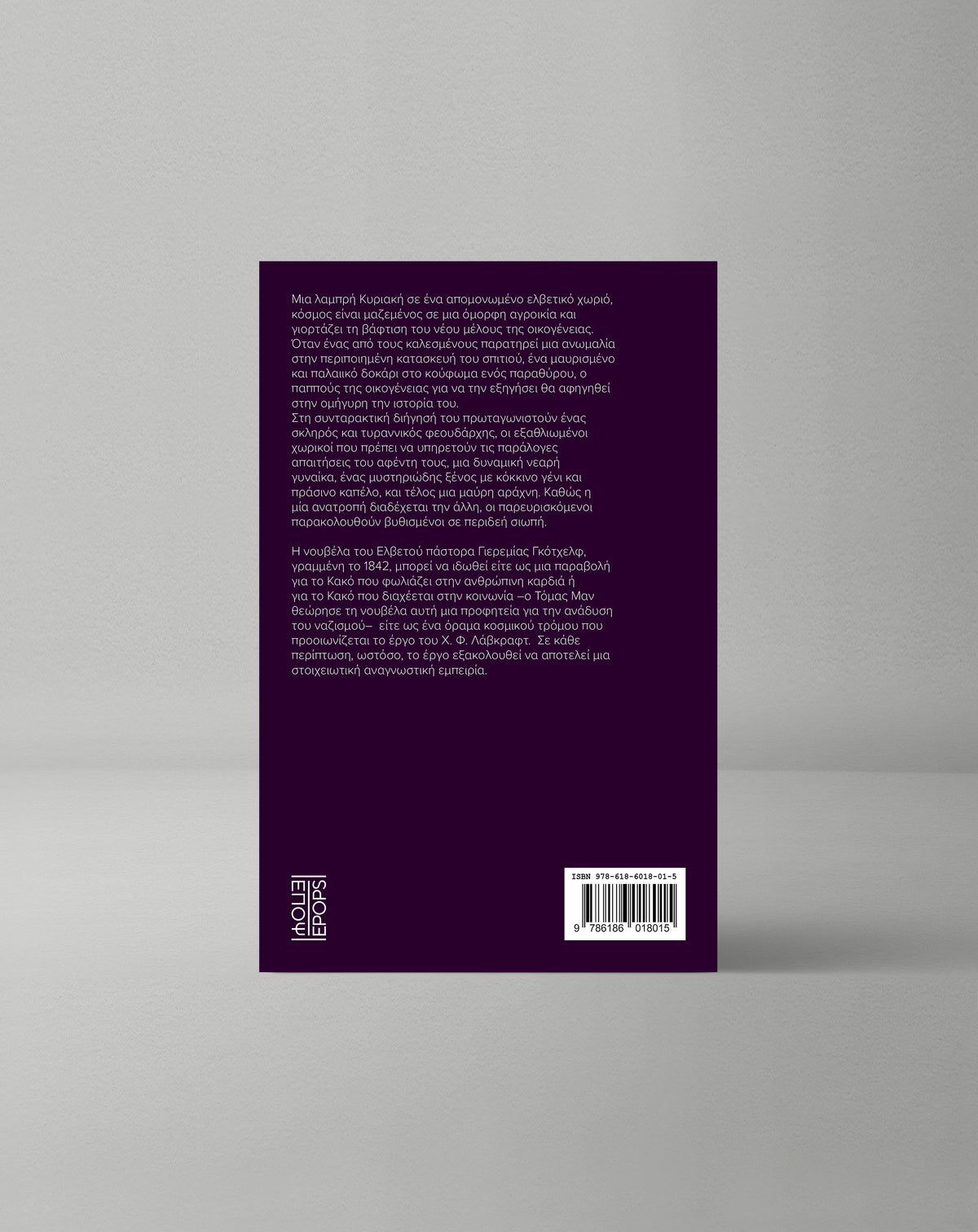
On a radiant summer Sunday in a secluded Swiss village, a gathering has assembled at a beautiful farmhouse to celebrate the baptism of the family’s newest member. When one of the guests notices something unusual in the house’s carefully maintained structure—a blackened, ancient beam in the frame of a window—the family’s grandfather explains it by telling the assembled company its story.
His gripping tale features a cruel and tyrannical feudal lord, impoverished peasants forced to meet their master’s unreasonable demands, a strong-willed young woman, a mysterious stranger with a red beard and a green hat, and, finally, a black spider. As one startling turn follows another, those present listen in fearful silence.
Written in 1842, the novella by the Swiss pastor Jeremias Gotthelf may be read either as a parable about the Evil that lurks in the human heart, or about the Evil that spreads throughout society—Thomas Mann regarded it as a prophecy of the rise of Nazism—or as a vision of cosmic horror that anticipates the work of H. P. Lovecraft. In every case, however, it remains a haunting reading experience.